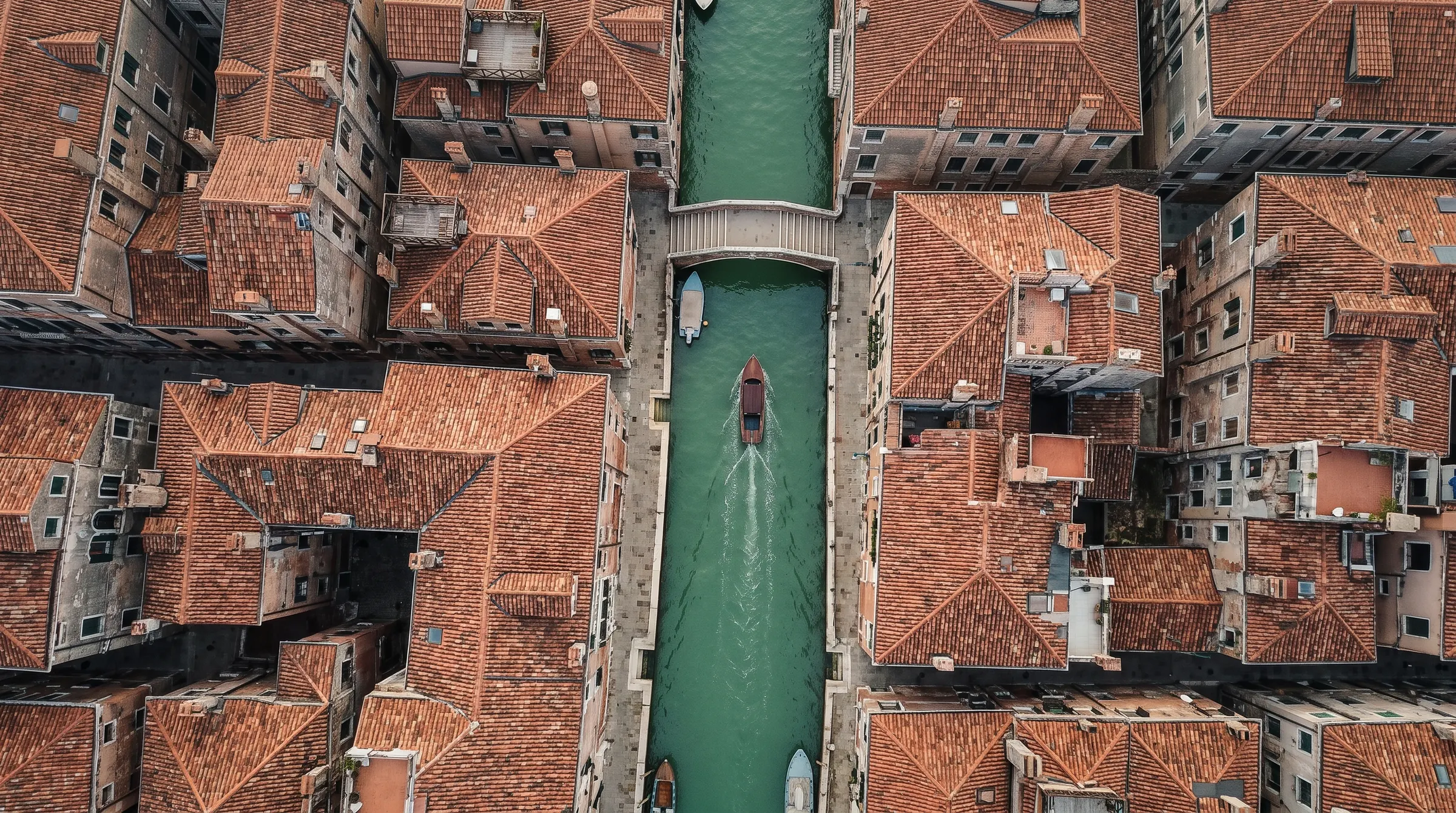
Venice has no neighbourhoods. It has six sestieri, its historic districts, divided by the Grand Canal, and its islands. Each has its own light, its own rhythm and its own kind of home. Choosing one comes before choosing the house.
San Marco
The ceremonial heart: the Piazza, La Fenice, the grand hotels. Here stand the most celebrated palazzi, facing the Grand Canal and the Bacino. It is the most visited sestiere, and so the most crowded too: those who choose it want to be centre stage.
Dorsoduro
The sestiere of museums and universities: the Accademia, the Guggenheim Collection, Punta della Dogana. The Zattere face south, onto the Giudecca Canal, with a light found nowhere else in Venice. It has always been the favourite of those who come from abroad to stay.
San Polo and Santa Croce
San Polo is the smallest and one of the oldest, around Rialto and its market: merchants' warehouse-houses (case-fondaco), Gothic palazzi, everyday life. Santa Croce is the closest to Piazzale Roma and the station: convenient for those who come and go, with very quiet corners towards San Giacomo dall'Orio.
Cannaregio
The sestiere where most Venetians live. Long straight canals, sunlit fondamenta, the Ghetto, the Madonna dell'Orto. To the north the lagoon opens out as far as the mountains. It has important palazzi and fewer crowds.
Castello
The largest. It runs from San Zaccaria to the Arsenale and on to the Biennale Gardens and Sant'Elena, where Venice has trees. The further you go from San Marco, the more it becomes a real city, with different spaces and different prices.
Giudecca, Lido and the islands
The Giudecca looks at Venice face on: former factories turned into homes with gardens and terraces, and the finest view of the city. The Lido is the island of the sea, of Liberty (Art Nouveau) villas and of cars. On the smaller islands, what you buy is silence.
What to look at, beyond the sestiere
The floor: the piano nobile, the principal floor, has the high ceilings and the Gothic multi-light windows; the top floor has the light and often an altana, the wooden roof terrace. The outlook: Grand Canal, side canal, campo, garden. The access: the distance from a landing and from a vaporetto stop, the water gate (porta d'acqua), the mooring. And the level of the ground floor relative to the tide.
Frequently asked questions
- Which is the most sought-after sestiere?
- For a Grand Canal frontage, San Marco and Dorsoduro. But the home matters more than the address: a piano nobile in Cannaregio is worth more than a mezzanine in San Marco.
- Where is the best place to live all year round?
- Where the Venetians stay: Cannaregio, Castello, parts of Dorsoduro and the Giudecca.
Do you own a home that Venice will not repeat?